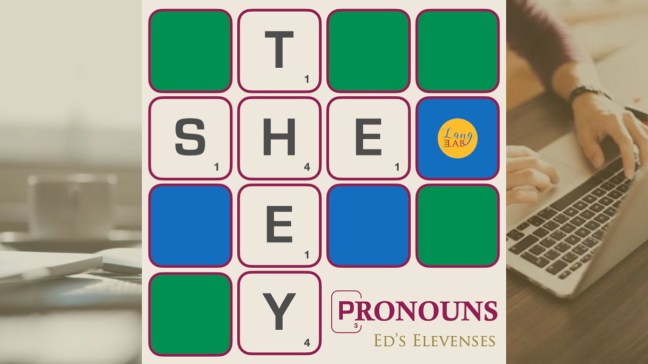
“What’s your pronoun?” appears to have become one of the many polite ways with which to start a conversation nowadays. The answer to this question has indeed been an important element of one’s bio on social media these days, for example, Amy Chan (she/her) and David Baker (they/them). In this Ed’s Elevenses blog post, we will look briefly into the use of “he”, “she” or “s/he” versus that of “they”, in particular, in contexts when you are not sure about a gender or just want to be as open-minded and accepting as you can be, and respect someone’s gender expression.
The man in the past
In a traditional manner, third person singular pronouns in the English language include: he, his, she, her, it, its, one, etc. When we want to refer to someone (as opposed to something) of unspecified sex, it was customary to use the masculine set of pronouns back in the days, that is, he, his, him, and himself:
➡️ Remind your child that he should brush his teeth.
➡️ Every student has to do his homework by himself.
Either…or…
However, it became apparent that such an approach is sexist, so people started using a more gender-neutral language when writing about a person without identifying whether said person is male or female. The third person singular pronouns thus include he or she, his or her, his or hers, him or her, and himself or herself:
➡️ Remind your child that s/he should brush his or her teeth.
➡️ Every student has to do his/her homework by himself/herself.
Plural they
This has been working well for years, though it looks quite clumsy as you will need to keep repeating “X or Y” or “X/Y” throughout a piece of writing in order to be consistent. Alternatively, you can also use third person plural pronouns (i.e., they, their, theirs, them, and themselves):
➡️ Remind your children that they should brush their teeth.
➡️ Students have to do their homework by themselves.
Singular they
As language continues to evolve and change, so do identity and gender expression, the third person singular they has become an even more preferable, mainstream gender-neutral pronoun in today’s society:
➡️ Remind your child that they should brush their teeth.
➡️ Every student has to do their homework by themself / themselves.
The use of third person singular they is an effective way to acknowledge that gender identities are no longer exclusively masculine or feminine, and non-binary people have the right to identify with a gender that is different from their assigned sex. Therefore, using singular they to refer to someone when we are unsure of their gender or when we want to recognise their identity can show that we genuinely care about who these people really are and can show them our basic respect as a human being.
“They are” or “They is”?
Although some grammarians regard singular they as erroneous, its use can in fact be traced back to 1375, where it appears in the medieval text William and the Werewolf, according to the OED. The only grammatical point to which I would like to draw your attention, is the subject-verb agreement:
✅ Peter says they want a cup of tea.
❌ Peter says they wants a cup of tea.
Always, always remember that, even when you are using singular they, the verb that follows has to be plural, in order to agree with the subject they (chiefly plural). If this eludes you, then consider the pronoun you, which can be singular as well as plural:
✅ You are my friend.
❌ You is my friend.
✅ You are my teammates.
❌ You is my teammates.
To learn more about the differences between singular and plural they, you may also want to read: Themselves or Themself?
Edison Tam MA MCIL CL is a Translator, Proofreader, and Copyeditor (zh-hk/en) who works with students, independent non-fiction writers, academic researchers, and clients from businesses and organisations of all sizes.
He is Chartered Linguist and Member of the Chartered Institute of Linguists (CIOL), and has undergone wide-ranging academic training in Business, Modern Languages, and Applied Linguistics in Hong Kong, London, and Barcelona.
 The Languaging Lab | 香港翻譯校對服務