“Future” can be used as an adjective or a noun. In this Ed’s Elevenses blog post, let’s look at some examples and find out whether or not “future” takes any article, and if so, when.
Future or The Future?
“Future” can be used as an adjective or a noun. In this Ed’s Elevenses blog post, let’s look at some examples and find out whether or not “future” takes any article, and if so, when.
“Are you going to make my work perfect?” is a question or rather a desire often expressed by clients. In this Ed’s Elevenses blog post, I am going to be full and frank about whether or not editorial perfection is a realistic expectation and an achievable mission. I hope clients, authors, and language users alike will benefit from understanding the pragmatic considerations underlying editorial work, and join us in contributing to a healthier editor–client relationship.

Back in the days, I suppose the majority of us were taught phrases such as “They did it themselves.” and “They treat themselves some ice-cream.” In this Ed’s Elevenses blog post, let’s find out whether “themselves” is always the preferred reflexive pronoun or not.
“What’s your pronoun?” has become a polite way with which to start a conversation nowadays. In this blog post, we will look into the use of “he”, “she” or “s/he” versus that of “they”.

“To boldly go where no man has gone before.” In this Ed’s Elevenses blog post, we will focus on structures like “to boldly go”, which are also known as split infinitives, and look briefly into why they have been a source of grammatical controversy for centuries.

Although both “super” and “superb” are common, they are not entirely interchangeable. In this Ed’s Elevenses blog post, we will look at the difference between these two words, and explain which of them is correct to use and when. I hope you won’t be confused by them again after reading this post!

“Your vs You’re” may be one of the most common offences with which social media users are often charged by the grammar police. In this Ed’s Elevenses blog post, we will look at the three (and sometimes four) major functions of apostrophes and ways to use them appropriately in writing.

Talking about age in writing may sometimes be tricky. In this Ed’s Elevenses blog post, we will look at various ways to deal with age. The simplest way to determine when to hyphenate “year old” (or indeed all the “old”s, like “week old” and “minute old”) would be to look for the position of the age in relation to the noun.
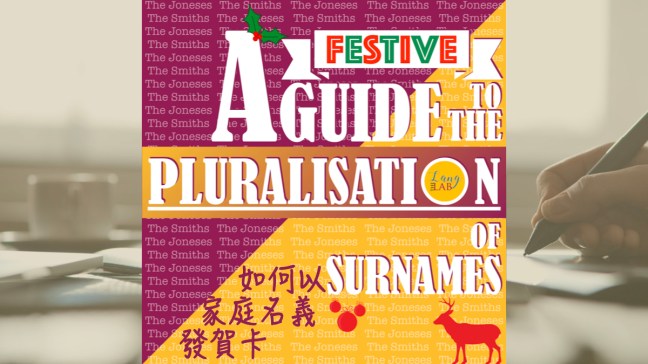
細閱着親朋戚友寄來的英文聖誕賀卡時,發現賀卡下款中有一個礙眼的撇號(apostrophe)......

There was nothing strenuous in the room apparently - the glass of something was gratifyingly simple to make, the handmade cards were a great joy to read...It was, however, when the alien apostrophe took over the stage the joyousness was flawed and my zing was smitten.
 The Languaging Lab | 香港翻譯校對服務